
"Bond selection is primarily a negative art. It is a process of exclusion and rejection, rather than of search and acceptance." - Benjamin Graham
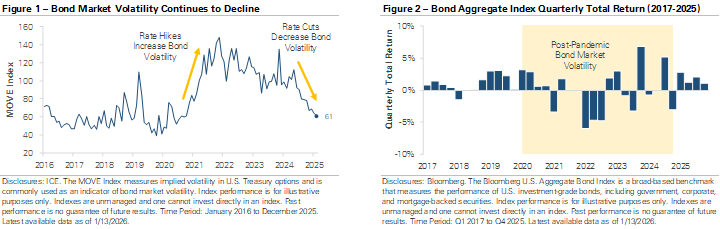
The bond market is emerging from a turbulent few years marked by shifting market conditions and increased volatility. Figure 1 graphs the MOVE Index, a measure of volatility in the U.S. Treasury market. Like the more well-known VIX Index, higher readings signal expectations for more bond market volatility. The bond market was stable in the late 2010s, but when the pandemic struck in 2020, it became more volatile. The MOVE Index spiked above 100 as the pandemic and economic uncertainty made financial markets more volatile, but it quickly retreated as the Federal Reserve cut interest rates to near 0%. The bond market was significantly less volatile in 2021 as the economy reopened and the Fed held interest rates steady, although rising inflation and expectations for Fed rate hikes caused volatility to creep higher.
From early 2022 to mid-2023, the bond market was extremely volatile as the Fed raised interest rates by 5.25%, one of the fastest and steepest rate-hiking cycles in modern history. Bond market volatility, which was already rising due to soaring inflation and Fed policy uncertainty, remained high throughout the entire rate-hiking cycle. The MOVE Index climbed back above 100 and peaked near 150 in late 2022, with bonds behaving as a source of risk rather than diversification. However, since late 2022, bond market conditions have steadily improved. Inflation has cooled, the Fed has cut interest rates by -1.50%, and recession concerns have eased. The MOVE Index is in the low 60s, the lowest since 2021. While there have been periods of volatility around key economic data releases and Fed meetings, the path has been smoother.
Bond market returns followed a similar pattern over the past five years. Figure 2 graphs the quarterly total return of the Bloomberg U.S. Aggregate Bond Index, the standard benchmark for U.S. investment-grade bonds. The index generated positive returns in ten of the twelve quarters from 2017 to 2019, but its returns have been more volatile since 2020. It declined by 1.5% in 2021 and 13% in 2022 as inflation soared to a 40-year high and the Fed aggressively hiked rates, a rare sequence of negative back-to-back annual returns. The volatility and negative returns are consistent with the high MOVE Index. Bond market conditions stabilized in late 2023 and 2024, and in 2025, the bond market regained its footing. The Bond Aggregate produced a positive return in each quarter and gained +7.3% for the full year, its strongest year since 2020.
What does this mean for your portfolio?
The past few years have tested the role of fixed income in portfolios. Today, the combination of lower interest rate volatility and higher starting yields points toward a more familiar risk and return profile. Bonds could still experience volatility if inflation or policy expectations shift again, but they’re behaving more like an asset class that can provide a blend of diversification and income. As bond market conditions normalize, now may be a good time to revisit your fixed income allocation and ensure your portfolio remains aligned with your long-term goals.
IMPORTANT DISCLOSURES
Clare Market Investments, LLC is a registered investment advisor. This material is for informational purposes only. It is not intended as and should not be used to provide investment advice and is not an offer to sell a security or a recommendation to buy a security. The information is derived from sources believed to be reliable and accurate as of the date of this report, but Clare Market has not audited this information to validate accuracy. Further, information may be at a point in time and subject to change. This summary is based exclusively on an analysis of general market conditions and does not speak to the suitability of any specific proposed securities transaction or investment strategy. Judgments or recommendations found in this report may differ materially from what may be presented in a long-term investment plan and are subject to change at any time. This report’s authors will not advise you as to any changes in figures or views found in this report. Investors should consult with their investment advisor to determine the appropriate investment strategy and investment vehicle. Investment decisions should be made based on the investor’s specific financial needs and objectives, goals, time horizon, and risk tolerance. Except for the historical information contained in this report, certain matters are forward-looking statements or projections that are dependent upon risks and uncertainties, including but not limited to such factors and considerations such as general market volatility, global economic risk, geopolitical risk, currency risk and other country-specific factors, fiscal and monetary policy, the level of interest rates, security-specific risks, and historical market segment or sector performance relationships as they relate to the business and economic cycle. See claremarket.com for additional information and disclosures. © 2026 Clare Market Investments, LLC. All Rights Reserved.