
"Over time, staying invested has mattered far more than getting the timing right." - Larry Fink
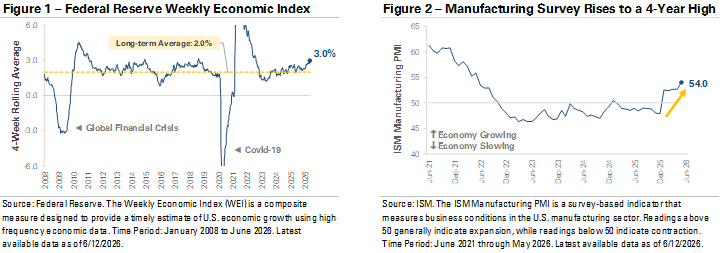
Most economic reports are released with a delay, which means investors are often looking at what happened weeks or even months ago after economists have had time to gather the data. The Federal Reserve's Weekly Economic Index helps fill that gap by providing a more up-to-date snapshot of economic activity. The index combines several real-time measures of the economy, including consumer spending, employment trends, rail activity, electricity use, fuel sales, and steel production, to estimate the economy's growth rate. Through the first half of 2026, the estimate has run around +3%, well above the long-term average growth rate of +2.0% (Figure 1). The signal has been consistent: the economy remains on solid footing in 2026.
Manufacturing activity tells a similar story. The ISM Manufacturing Index, a widely followed survey of purchasing managers at factories, rose to 54 in May, its strongest reading in four years (Figure 2). May was the fifth straight month above 50, the threshold that signals expansion, with 16 of 18 industries reporting growth. After a challenging period from 2023 through most of 2025, manufacturers are benefiting from lower interest rates and increased business investment. Tech companies are investing hundreds of billions into data centers, computer chips, and power infrastructure, providing an additional boost to the manufacturing sector. In addition, some businesses appear to be pulling orders forward due to concerns that the Middle East conflict could push oil prices and production costs higher.
Labor market data shows a similar story. Hiring picked up in early 2026 after slowing in the second half of 2025. Employers added 172,000 jobs in May, with the prior two months revised higher, and unemployment has declined from a peak of 4.5% late last year to 4.3%. Consumers, who account for nearly 70% of economic activity, are still spending, though at a modestly slower pace than a year ago. The reports reflect past activity, but they reinforce the message coming from the real-time data: economic growth remains solid.
As we move into the second half of 2026, the economy continues to show resilience, even as the headlines remain unsettled. The Middle East conflict has pushed oil and gas prices higher and kept inflation above the Fed's 2% target. Interest rates have come down but remain elevated, and with inflation still running above target, the Fed appears likely to hold interest rates steady the remainder of this year. None of that has derailed the economy so far. The big story of 2026 is an economy that has kept growing through a noisy and uncertain stretch.
The broader lesson for investors is that economic progress rarely arrives with a clear signal. Growth often occurs alongside uncertainty, unsettling headlines, and reasons to stay on the sidelines. Yet history shows that staying invested through periods of uncertainty has generally mattered far more than trying to predict every twist and turn. Through the first half of 2026, the economy has continued to demonstrate that resilience.
IMPORTANT DISCLOSURES
Clare Market Investments, LLC is a registered investment advisor. This material is for informational purposes only. It is not intended as and should not be used to provide investment advice and is not an offer to sell a security or a recommendation to buy a security. The information is derived from sources believed to be reliable and accurate as of the date of this report, but Clare Market has not audited this information to validate accuracy. Further, information may be at a point in time and subject to change. This summary is based exclusively on an analysis of general market conditions and does not speak to the suitability of any specific proposed securities transaction or investment strategy. Judgments or recommendations found in this report may differ materially from what may be presented in a long-term investment plan and are subject to change at any time. This report’s authors will not advise you as to any changes in figures or views found in this report. Investors should consult with their investment advisor to determine the appropriate investment strategy and investment vehicle. Investment decisions should be made based on the investor’s specific financial needs and objectives, goals, time horizon, and risk tolerance. Except for the historical information contained in this report, certain matters are forward-looking statements or projections that are dependent upon risks and uncertainties, including but not limited to such factors and considerations such as general market volatility, global economic risk, geopolitical risk, currency risk and other country-specific factors, fiscal and monetary policy, the level of interest rates, security-specific risks, and historical market segment or sector performance relationships as they relate to the business and economic cycle. See claremarket.com for additional information and disclosures. © 2026 Clare Market Investments, LLC. All Rights Reserved.